
Christianity holds the maximum percentage of the population in the world, though not the oldest religion as compared to others.
This religion is based on the teachings of Jesus Christ along with his birth, death and resurrection.
Around 26% of the world’s population are Christians; in the course of time, Christianity was divided into many groups called denominations.
Catholicism formed around 1054 AD, which was the first denomination under the religion.
In the 16th Century, Martin Luther perceived a few mistakes in the practices of the Catholic Church and formed Protestantism.
Key Takeaways
- Catholicism is the largest Christian denomination, with the Pope as its spiritual leader, while Lutheranism is a Protestant denomination that emerged from the teachings of Martin Luther during the Reformation.
- Lutheranism emphasizes the “Sola Fide” (faith alone), asserting that salvation comes through faith alone in Jesus Christ, without the need for good works. At the same time, Catholicism teaches that faith and good works are both necessary for salvation.
- The structure of the Catholic Church is hierarchical, with the Pope at the top, followed by bishops and priests. At the same time, Lutheranism has a less centralized structure, with congregations having more autonomy.
Catholic vs Lutheran
The difference between Lutherans and Catholics is that Lutherans believe Grace and Faith alone can save an individual, whereas Catholics believe that faith, formed by love and work, can save.
The difference between them is that the Catholics firmly believe that doing good work with faith towards God brings salvation.
Lutherans believe that showing love and faith in Jesus Christ brings them salvation.
Comparison Table
| Parameter of Comparison | Catholic | Lutheran |
|---|---|---|
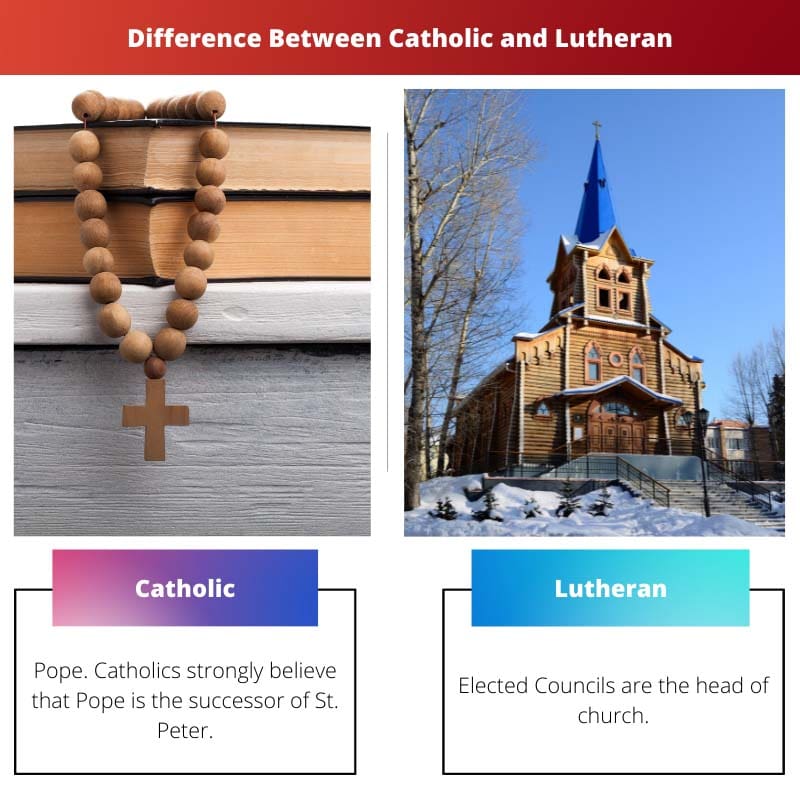
| Head of Church | Pope. Catholics strongly believe that Pope is the successor of St. Peter. Pope is considered to have supreme authority. | Elected Councils are the head of the church. |
| Importance of the Bible | Bible and Church Tradition is the source of truth | Bible alone is the only source of truth |
| Salvation | It is achieved through faith and good works | It is achieved through faith |
| Sacraments | Catholics believe in 7 Sacraments | Lutherans believe in 2 Sacraments |
| Traditions | Followed based on Church’s orders | Followed based on the Bible |
What is Catholic?
They are considered to be the foremost Christians. Believed and formed Jesus Christ: The Son of God, formed a Christian community with twelve disciples, otherwise called Apostles.
The advancement of the Christian community, which the Twelve Apostles formed, is the Catholic Church.
The Church’s leader is the Apostles’ successor, the Bishop of Rome, otherwise called s Pope.
Jesus Christ appointed St. Peter to be the head of the Church initially in the first century AD.
So, the appointed Pope is the sole successor of St. Peter.
Catholics have a firm belief in Baptism. The belief of every human born in the world is born with sin, and only baptism can remove it.
The church is the one true church for the Catholics.
Catholics’ belief is the distinctive way of looking at the Pope as the only Vicar of Christ on earth.
Bible is deeply worshipped as the inspired word of God.
The Catholic Church in Rome has protected the original scriptures of the Bible for so many years.
Mother Mary, the mother of Jesus Christ, is worshipped as the first among all the saints. Mother Mary is also considered to be the mother of the Church.
Catholics do not pray to any statues; They pray to God. Catholics believe in the resurrection and not reincarnation.


What is Lutheran?
A solid effort to reform Roman Catholic Church in the 1500s gave rise to Protestantism.
Martin Luther, the Bible Professor at the University of Wittenberg then, started this movement.
The political and academic climate that existed in Europe gave impetus to the Reformation.
In 1521, there was a split between Christianity, Catholics and Lutherans.
Martin Luther never liked the name Lutheran; instead supported the Evangelical name meaning ‘Good news’.
The German Theologian, Dr Johann Maier von Eck, kept the term Lutheran.
The faith of Lutherans is based on doctrines laid out by Martin Luther. In the year 1625, the first Lutheran Church was set up.
Lutherans strongly condemned the authority of the Pope. Their belief lay only in Bible.
Heaven and Hell are literal places for the Lutherans. Hell is considered to be the place of punishment, whereas heaven is the place of God.
Lutherans reject a lot of practices by Catholics.
They strongly condemn the fact that salvation can happen only through the grace of faith in God and not by any other means.
Lutherans practice Baptism, however, does not believe in the fact of sin cleansing practice.
They believe that humans can be saved only by grace through faith in God and the bible.
| # | Preview | Product | |
|---|---|---|---|
| 1 |

|
The Lutheran Book Of Prayer | Check Price on Amazon |
| 2 |

|
Concordia: The Lutheran Confessions -- A Reader's Edition of the Book of Concord | Check Price on Amazon |
Main Differences Between Catholic and Lutheran
Christianity never had any differences until the Church’s authorities’ indulgence towards money grew.
When Martin Luther questioned the same, along with like-minded followers, a new movement formed.
Lutherans set their own doctrines in line with Christianity and followed the same.
Though the serenity of the religion is never damaged, there were a few prime differences between the Catholics and the Lutherans.
- The Lutherans totally contradicted the central Catholic belief that faith formed by love and work alone can save a person from sins. They believe in the concept of faith and that Christ alone can save a person.
- Lutherans believe traditions are to be followed as per scriptures, but the Catholics follow the Church orders also.
- Catholics view Mother Mary as the Queen of Heaven. In fact, praying to God through her is a tradition followed by them too, whereas Lutherans emphasize direct access to God and give less prominence to Mother Mary.
- Catholics have proper authority in Pope, whereas the Lutheran churches function independently without any apparent ONE authority for all the churches.
- Catholic Bible has 73 books, whereas Lutheran Bible has 66.
- https://pure.mpg.de/rest/items/item_1233938/component/file_1819230/content
- https://go.gale.com/ps/i.do?id=GALE%7CA58049186&sid=googleScholar&v=2.1&it=r&linkaccess=abs&issn=10475141&p=AONE&sw=w
Last Updated : 13 July, 2023


Chara Yadav holds MBA in Finance. Her goal is to simplify finance-related topics. She has worked in finance for about 25 years. She has held multiple finance and banking classes for business schools and communities. Read more at her bio page.


This detailed comparison provides a comprehensive understanding of the theological variances between Catholicism and Lutheranism. It’s an important resource for those interested in the subject.
Indeed, the article effectively highlights the nuanced differences in doctrine and tradition between these two branches of Christianity.
The analysis helps to debunk misconceptions and fosters a deeper understanding of these religious traditions.
The article’s depth of analysis and detailed comparison of the beliefs and practices of Catholicism and Lutheranism makes it a valuable scholarly resource.
Agreed, the article effectively elucidates the essential differences between these two Christian traditions.
The history and theological differences between Catholicism and Lutheranism are well-explained here. Both are important branches of Christianity and it’s crucial to understand their distinctions.
Agreed, this article presents a balanced view of these two important denominations.
The comparison table is particularly useful to understand these differences at a glance.
The comparison provides a thorough and detailed study of the differences in beliefs and practices of Catholicism and Lutheranism, contributing to interfaith awareness.
The article is an invaluable resource for promoting interfaith understanding and dialogue.
Understanding the theological variances between these two influential Christian traditions is essential for religious literacy and harmony.
The article presents a detailed and objective comparison of Catholicism and Lutheranism, highlighting their core theological differences and practices.
The doctrinal differences and historical context provided here are particularly helpful for understanding these religious traditions.
The article presents a scholarly and insightful comparison of Catholicism and Lutheranism, offering a nuanced understanding of their doctrinal distinctions.
Absolutely, the article sheds light on the core theological differences between these two historic branches of Christianity.
This is a thorough and informative comparison of Catholicism and Lutheranism, with an emphasis on their differences in beliefs and practices.
I appreciated the historical context provided here, it helps to understand the origins and development of these branches of Christianity.
Yes, this comparison is quite enlightening for those who want to understand the differences between these two denominations of Christianity.
The comprehensive explanation of the differences in beliefs and practices of Catholicism and Lutheranism is quite illuminating and clears up many misconceptions.
Absolutely, understanding these distinctions is crucial for interfaith dialogue and harmony.
The article provides a scholarly and well-researched comparison of the beliefs and practices of Catholicism and Lutheranism.
An in-depth analysis of the historical background of these two major branches of Christianity. Very informative.